A children’s manuscript may look short on the page, but producing the finished book requires many connected decisions. The words must fit the intended reader, each page turn should support the story, the characters need visual consistency, and the final files must satisfy the specifications of the selected printer or publishing platform. Changing one decision late can affect the art, page count, cover and production cost.
This scenario follows an anonymous first-time author with a warm story about courage and friendship. The draft has a clear message and a memorable main character, but it has not been edited for a defined age range. There is no page map, trim size, illustration brief or approved visual style. The author wants a color print edition and a digital edition but has not yet selected platforms or tested a proof.
The challenge
The central challenge is not simply to add pictures. Text, illustration and format must be planned as one reading experience. The original draft repeats information that the artwork could communicate, introduces the conflict slowly and gives several important moments too little space. If full illustrations began immediately, later editorial changes could require expensive redraws.
There is also a rights question. The author would need a written agreement explaining who owns or licenses the final artwork, what uses are permitted and which source files will be delivered. The U.S. Copyright Office explains that original books and illustrations can be protected once fixed in a tangible form, while ownership can also be transferred through contracts. That makes rights documentation an early production task, not an afterthought.
Goals for the illustrative project
- Define the intended age range, tone and approximate reading experience.
- Edit the story while preserving the author’s voice and central message.
- Create a page-by-page visual plan before commissioning final artwork.
- Establish consistent characters, settings, palette and illustration style.
- Prepare platform-appropriate print and digital files, then review proofs.
- Document deliverables, approvals and artwork usage rights clearly.
The proposed strategy
1. Editorial diagnosis and audience definition
The US Publisher could begin with an editorial assessment rather than a full rewrite. The editor would identify the target reader, clarify the story arc, mark repeated or abstract passages and check whether the vocabulary and sentence rhythm suit the intended read-aloud or independent-reading experience. The author would approve substantive changes before the team treated the text as final.
2. Page map and visual brief
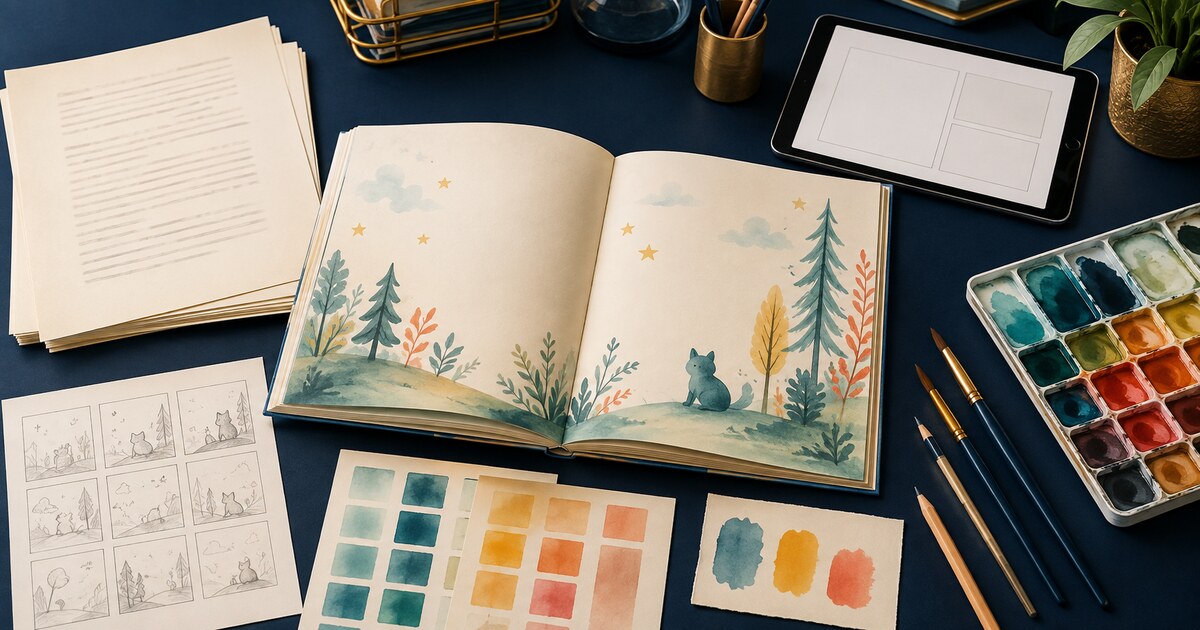
Next, the edited text could be divided into pages or spreads. A page map would show where the story turns, where suspense builds and where an illustration can replace explanation. Each scene would receive a short brief covering action, setting, emotion, continuity and available space for text. This plan creates a shared reference for the author, illustrator and designer.
3. Character and style approval
Before producing finished spreads, the illustrator could prepare character sketches, a palette and one representative style sample. The author would review these against agreed criteria instead of directing every brushstroke. Once approved, a visual guide would record clothing, proportions, recurring objects and environmental details so the character does not change unexpectedly between pages.
4. Illustration in controlled stages
Rough thumbnails would come before detailed sketches, and detailed sketches before final color. Review points at each stage would reduce the risk of major rework. Feedback could be consolidated into one numbered document, with each requested revision tied to a specific spread. New scenes or concept changes after approval would be treated as scope changes rather than hidden inside routine corrections.
5. Layout and technical production
With art and text approved, the designer could build the interior around the chosen trim size, margins, bleed and binding. Current Amazon KDP guidance recommends a minimum image resolution of 300 DPI and requires artwork intended to reach the page edge to extend 0.125 inches beyond the trim on the relevant sides. B&N Press likewise recommends illustrations at 300 DPI or higher and warns that printed color may not exactly match an RGB screen.
The digital edition would be planned separately instead of being assumed to be the print PDF. Image-heavy children’s eBooks may use fixed-layout production; Amazon currently accepts KPF or EPUB for fixed-layout titles and recommends previewing files before publication. The selected platform’s current rules should be confirmed before final delivery.
Illustrative workflow and milestones
- Week 1: project brief, audience definition, editorial assessment and rights checklist.
- Week 2: revised manuscript, page map and illustration brief approved by the author.
- Week 3: character concepts, palette and one style sample reviewed.
- Weeks 4–6: thumbnails, sketches and final artwork completed in agreed batches.
- Week 7: print interior, cover and digital-format preparation.
- Week 8: digital preview, physical proof review and documented corrections.
These milestones are illustrative only. Actual timing would depend on page count, illustration complexity, revision rounds, author response time and platform requirements. No publishing date should be promised until the text, art and specifications are stable.
Proposed deliverables
A responsible scope could include the edited manuscript, page map, visual brief, character guide, approved illustrations, print-ready interior, format-specific cover, digital file, metadata worksheet and pre-publication checklist. It should also state what is excluded, how many revision rounds are included, which files the author receives and whether any fonts, stock elements or artwork carry separate license terms.
Risks the workflow is designed to reduce
- Starting art too early: lock the narrative and page map before final illustration.
- Inconsistent characters: approve a visual guide and check continuity across every spread.
- Low-resolution files: evaluate art at its intended print size, not by changing the DPI label.
- Late format changes: select trim, color and binding before the final layout.
- Unexpected print color: examine a physical proof and allow for screen-to-print variation.
- Unclear rights: document ownership, licenses and permitted uses in writing.
Lessons for children’s book authors
The most valuable lesson is that sequencing protects both quality and budget. Editing before illustration, approving concepts before final color and proofing before release make corrections easier to manage. Authors should also distinguish a completed production file from a market result: professional preparation can improve readiness, but it cannot guarantee retailer acceptance, rankings, reviews or sales.
Plan your children’s book before commissioning every page
The US Publisher can review a manuscript and propose a project-specific editorial, illustration and production plan. Any recommendation, schedule and price should be based on the actual manuscript, intended formats, artwork complexity and rights requirements; publication or sales outcomes are never guaranteed.
Call +1 737-282-5860 or email info@theuspublisher.com to request a children’s book project assessment.
Official resources: Amazon KDP: Format Images in Your Book, Amazon KDP: Paperback Submission Guidelines, Amazon KDP: Fixed-Layout File Guidance, B&N Press: Including Photos and Illustrations, and U.S. Copyright Office: What Is Copyright?.
Disclaimer: This article is a fictional, illustrative case-study scenario for educational purposes. It does not describe a real client engagement or completed outcome. Platform specifications, copyright questions, schedules and project requirements can change; verify current rules and obtain appropriate legal advice for your circumstances.
 Autobiography